
HiPS
The Hierarchical Parcel Swapping (HiPS) model is a minimal model of turbulent mixing. It is formulated as a binary tree with levels defining a progression of smaller length and time scales that follow inertial-range turbulent scaling. Fluid parcels reside at the base of the tree. Mixing is modeled by instantaneous, stochastic eddy events implemented by swapping subtrees at different levels and using different base nodes. The model has shown remarkable agreement with fundamental turbulent mixing phenomenology, and can be used as a standalone tool or as a subgrid model in three-dimensional simulations.
The movie shows a HiPS tree illustrating the eddy events as subtree swaps. The parcels at the bottom of the tree are shaded by their resulting mixed state as the flow evolves from a step function in scalar value to fully mixing.

ODT
Full resolution of three-dimensional turbulence fields is very costly from a computational viewpoint.
The ODT model fully resolves a flow field along a notional line-of-sight.
Turbulent advection is simulated through stochastic eddy events that are implemented through grid rearrangements via triplet maps. These eddy events occur with a given size, location, and frequency that depends on the evolution of the velocity field itself, in a way that mimimics that turbulent energy cascade.
The video shows the vertical velocity up an isothermal wall. The ODT line is oriented horizonally and is evolved in the vertical direction as a parabolic flow. The velocity field changes due to instantaneous jumps as eddy events are implemented, with diffusive mixing of the momentum fields smoothing the profile between the eddy events.

Fire Modeling, LES
Fires are notoriously difficult to model due to the wide array of complex and interacting physical phenomena including radiative heat transfer, soot formation, turbulent multiphase flow, often unknown or poorly characterized fuel properties, and a wide range of time and length scales. We are using ODT and LES to study flames and fires at increasing scales.
The video shows an LES of a fire on a slope subject to wind. The simulation was performed using FDS to study radiative heating to surroundings for firefighter safety.

Soot formation
Soot formation in flames is an important physical process as it accounts for the majority of flame radiation and is a pollutant.
Soot is a particulate species with a low diffusivity resulting in strong differential transport between soot and gaseous species comprising the flame which affects soot temperature, formation and destruction, and emission. Modeling these processes in turbulent flames is aided by direct numerical simulation.
The movie shows soot evolution in DNS of a 3D, temporally-evolving, planar ethylene jet flame. Four slices down the axis of the jet are shown. The simulation is about 1x2x3 cm in size and is run for 1.1 ms at a cost of 1.5 million CPU-hrs. Two soot moments are solved along with a reduced ethylene mechanism consisting of 19 chemical species.

Flame Extinction and Reingition
Nonpremixed flames occur at the stoichiometric interface between fuel and oxidizer streams.
The rate of combustion in these flames is limited by the rate of diffusive mixing of the streams.
Turbulence acts to increase flame surface area and scalar gradients, hence increasing mixing.
As mixing rates increase, finite rate chemical kinetic effects become important, and flame extinction may occur if rates of diffusive heat loss exceed the heat release rates of combustion. Local flame extinction results in flame holes through which unburned fuel may escape, reducing combustion efficiency and allowing fuel emission. High rates of flame extinction may result in unstable combustion, flame liftoff, and if excessive, global flame blowout, posing operational and safety hazards.
Flame extinction and reignition are notoriously difficult processes to model due to the finite rate chemical kinetic effects, and complex reignition mechanisms that depend on the turbulent environment and flame structure. The degree of mixing in extinguished regions prior to reignition may affect the mode of reignition. The movie shows evolution of the 1700 K isocontour of temperature in a planar, temporally-evolving, ethylene jet flame. The flame starts as nonpremixed, undergoes extreme extinction to near blowout, then mixes in the abscence of a flame and reignites as a stratified premixed flame. ODT simulations of this configuration, along with cases with less extinction, have been performed.
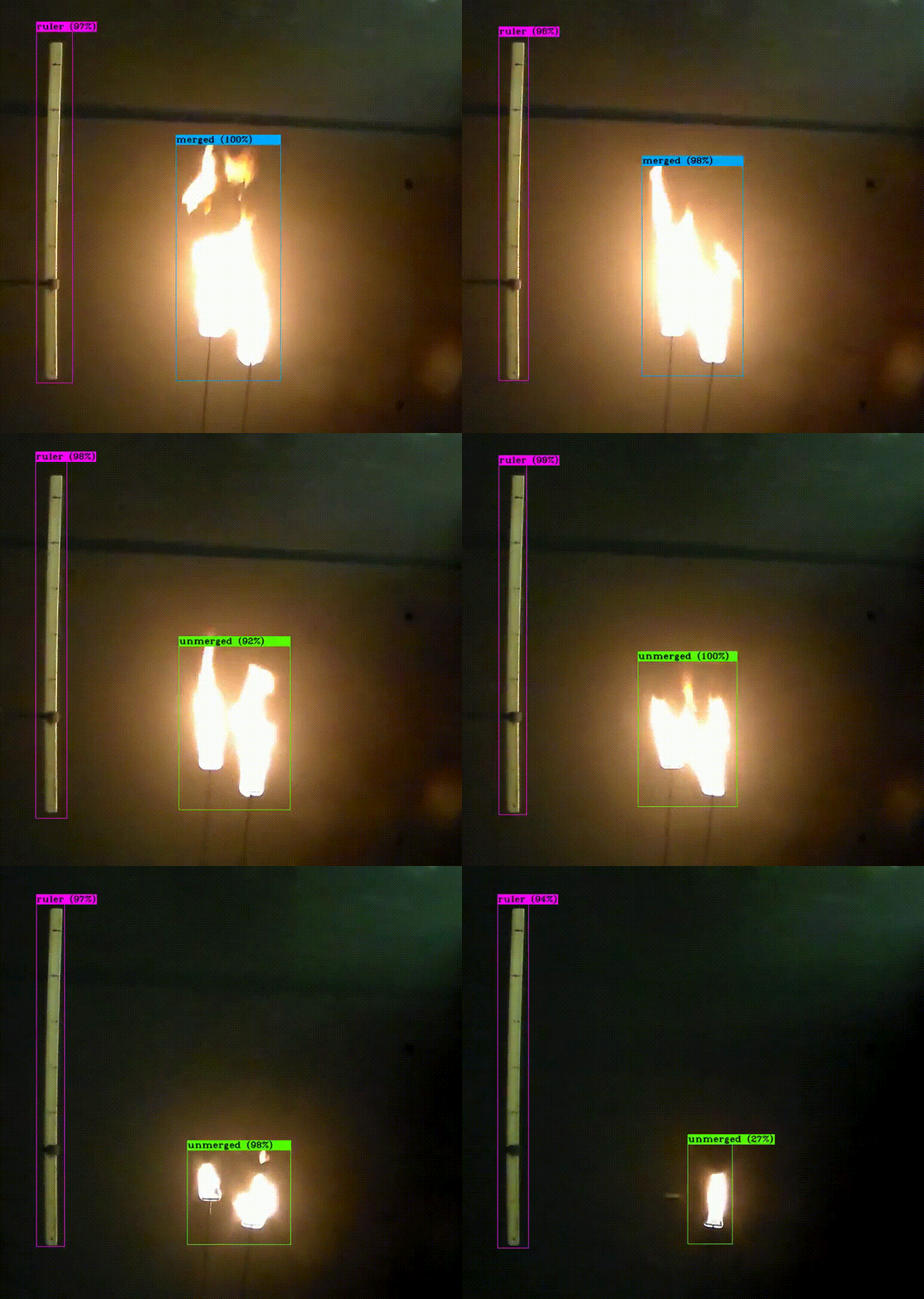
Flame Merging Image Detection
We have also performed ODT and LEM simulations of flame propagation through biomass fuel beds with application to wildland fires. Recent efforts have included machine learning for object detection in flame merging. An example is shown in the video here. This used the YOLOv4 object detection computer vision software trained on experimental videos of flame merging. Acurate detection and characterization of processes such as merging is very challenging to implement reliably without such tools.
