
Finite Volume Method
- So far we have discussed PDEs and ODEs using the finite difference (FD) method.
- Set a grid of discrete points.
* * * * *
- Approximate the derivatives in the ODE/PDE at those points.
- Solve for function values there.
- Note, in FD, the starting point is the PDE.
Finite Volume (FV) method
- Instead of a grid of points, make a grid of volumes.
      -------------------------------
      |     |     |     |     |     |
      -------------------------------
- Insted of using the PDE (differential conservation law), use the integral conservation law.
- This is a standard balance on control volumes:
- (accumulation) = (input) - (output) + (generation)
- This is a standard balance on control volumes:
3 equivalent approaches.
- Apply the above condition directly.
- Integrate the PDE over a given control volume (CV).
- Start from scratch and derive the governing equation from the conservation law (using the Reynolds Transport Theorem.)
Approach 1.
- 2-D unsteady heat transfer.
- Energy balance
- 2-D grid
- Control volumes i, j
- Control faces: e, w, t, b.
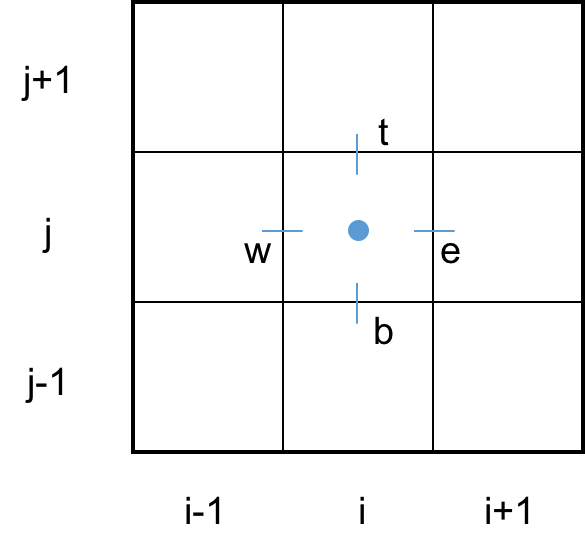
- Assume properties are uniform throughout a given cell.
- Assume properties are uniform along a cell face.
- (accumulation) = (in) - (out) + (generation).
* $E$ (=) J * $q$ (=) J/m$^2$s * $S$ (=) J/m$^3$s * $dE/dt = \Delta x\Delta y \rho c_pdT/dt.$
$$\color{blue}{\frac{dT_{i,j}}{dt} = -\frac{1}{\rho c_p}\left(\frac{q_{e,i,j}-q_{w,i,j}}{\Delta x_i}\right) - \frac{1}{\rho c_p}\left(\frac{q_{t,i,j}-q_{b,i,j}}{\Delta y_j}\right) + S_{i,j}.}$$- This equation is usually solved in this form, that is, in terms of fluxes.
- Note, $q_{e,i,j} = q_{w,i+1,j}$.
- Hence, energy is strictly conservered.
- This is an important property that is built-in to FV methods, but not necessarily for FD methods.
- This is especially true for nonuinform grids with variable properties.
- This is an important property that is built-in to FV methods, but not necessarily for FD methods.
Evaluate the fluxes.
$$\vec{q} = q_x\vec{i} + q_y\vec{j},$$$$q_x = -k\frac{\partial T}{\partial x},$$
$$q_e = -k\left.\frac{\partial T}{\partial x}\right|_e = -k\left(\frac{T_{i+1,j}-T_{i,j}}{\Delta x}\right),$$
$$q_w = -k\left.\frac{\partial T}{\partial x}\right|_w = -k\left(\frac{T_{i,j}-T_{i-1,j}}{\Delta x}\right),$$
$$q_t = -k\left.\frac{\partial T}{\partial y}\right|_t = -k\left(\frac{T_{i,j+1}-T_{i,j}}{\Delta y}\right),$$
$$q_b = -k\left.\frac{\partial T}{\partial y}\right|_b = -k\left(\frac{T_{i,j}-T_{i,j-1}}{\Delta y}\right).$$
- If we substitute this into the governing equation, then on a uniform grid we obtain:
- This is the same equation as the FD method (for a uniform grid).
- The the approach is different.
- Nonuniform grids are common.
- Again, we normally solve the equation in terms of fluxes, not with the fluxes substituted into the governing equation.
Approach 2
- Integrate the PDE over cell i, j
- $\partial/\partial t$ commutes with $\iint$.
- Assume $T$, $S$, $\alpha$ are uniform:
* Apply similarly for other terms.
- Our equation now becomes
(Again, repeating the previous equation)
$$\Delta x\Delta y\frac{\partial T}{\partial t} = \Delta y\alpha\left(\frac{\partial T}{\partial x}\right)_e - \Delta y\alpha\left(\frac{\partial T}{\partial x}\right)_w + \Delta x\alpha\left(\frac{\partial T}{\partial y}\right)_t - \Delta x\alpha\left(\frac{\partial T}{\partial y}\right)_t + S\Delta x\Delta y.$$- Now, using the following, etc., we obtain the same equation as approach 1.
Approach 3
- Use the Reynolds Transport Theorem (RTT).
- The RTT is in the form: (generation) = (accumulation) + \[(out) - (in)\].
- RTT:
- Here, $B$ is some extensive property (like total energy), and $\beta=B/m$ is the intensive property (like energy per unit mass).
- Let $B=E$ and $\beta = E/m=e$.
- In term (3), $\vec{v}=0$, no velocity, so term (3) = 0.
- In term (2),
-
In term (1) we apply the conservation law, which is the first law of thermodynamics:
$$\frac{dE}{dt} = \dot{Q} + \dot{W} + S\Delta x\Delta y.$$- There is no work: no velocity, and constant $\rho$.
- For $\dot{Q}$, we have $$\dot{Q} = -\int_{CS}\vec{q}\cdot\vec{n}d\mathcal{A} = -\left[\int_b() + \int_t() + \int_e() + \int_w()\right] = -[q_e\Delta y - q_w\Delta y + q_t\Delta x - q_b\Delta x].$$
-
Now, substitute the terms back in (and flipping the equation order):
$$\Delta x\Delta y \rho c_p\frac{dT}{dt} = -[q_e\Delta y - q_w\Delta y + q_t\Delta x - q_b\Delta x] + S\Delta x\Delta y.$$ -
Rearranging, this gives the same equation as in the other methods:
Discussion
- Note, we still use grid points when evaluating fluxes and properties. $$q_e = -k\frac{T_{i+1,j}-T_{i,j}}{\Delta x}.$$
Nonuniform grids
- Two approaches, called practice A and practice B. (See Patankar’s book Numerical Heat Transfer and Fluid Flow).
Practice A
- Faces are set midway between grid points:
    -----------------------------------------------------
    |   |                |              |        |      |
    *   |   *            |            * | *      |      *
    |   |                |              |        |      |
    -----------------------------------------------------
- Better accuracy for fluxes (derivatives have symmetric central differences).
- Has half a control volume at the boundaries
- In 2-D, face values are not at the center of faces.
Practice B
- Grid points are midway between cell faces:
    -------------------------------------------------------
    |   |   |             |                |        |      |
    | * | * |      *      |        *       |    *   |   *  |
    |   |   |             |                |        |      |
    -------------------------------------------------------
- Center value is a better representation of the value in the CV. This is better for evaluating source terms.
- Has a whole control volume at the boundaries